Understanding how mRNA vaccines work, through videos
mRNA is a "protein blueprint note" sent to the cell. Follow the six steps (design → packaging → cell entry → translation → immune training → natural breakdown) through short videos, and write one answer after each. Reference: theory slides (PDF, Korean)
0mRNA technology on one page 5 min
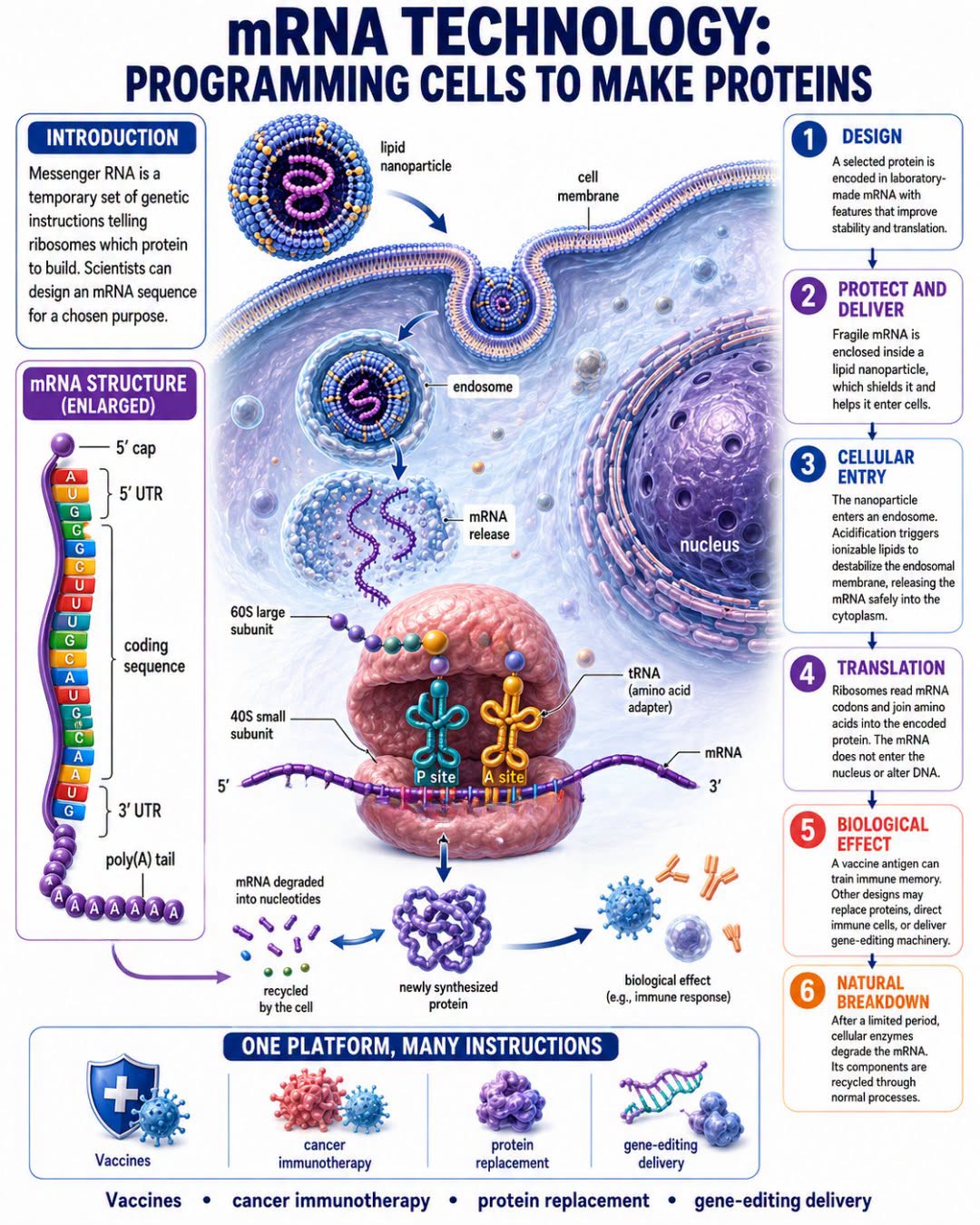
First read this poster slowly for two minutes. All of today's class is on this one page. Left: the structure of mRNA; middle: the journey inside the cell; right: the six steps. Click the image to open it full size.
1Why learn this 5 min
In 2020, humanity obtained a new kind of vaccine in a single year. Yet many people were afraid to take it. "It changes my DNA." "It was made too fast to be safe." "Something stays in my body." The same stories went around in Tanzania and in Korea. The root of the fear was mostly not knowing the principle. Today's goal is to understand that principle well enough to explain it to a friend.
2What a cell is made of: the four biomolecules 5 min
No biology or chemistry background needed. Only four kinds of molecule matter for understanding the vaccine. As the figure on the left shows, functional groups (–OH, –COOH, –NH₂, –PO₄ …) attached to a carbon skeleton give four large molecules, and chemical structure creates biological function.
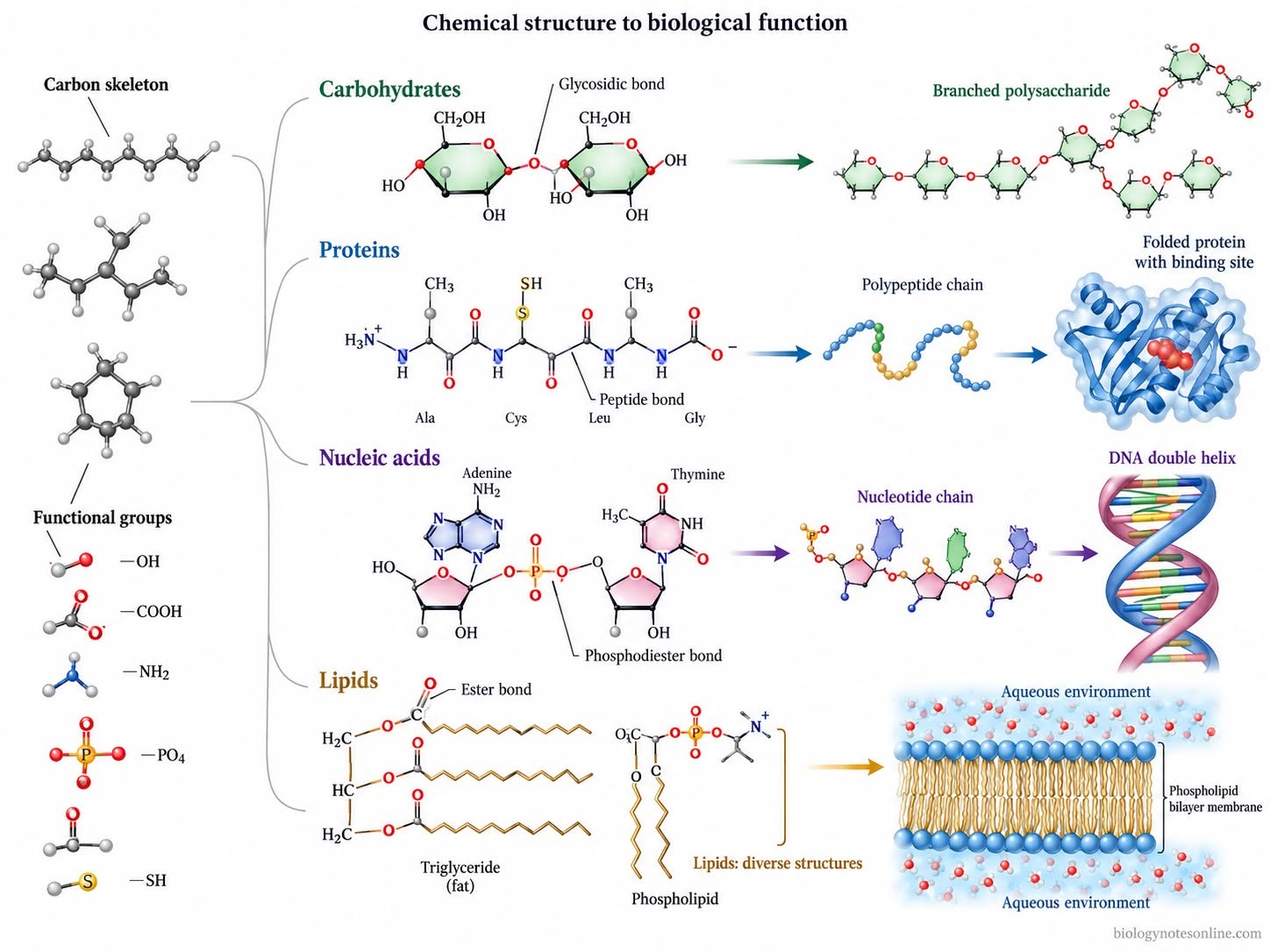
Two of them are today's main characters. Nucleic acid: the mRNA itself. Lipid: the wrapping that carries the mRNA to the cell. And the product is a protein, the antigen. Every scene that follows is the work of these three molecules.
3The central dogma: from blueprint to protein 10 min
The nucleus keeps the original (DNA) and copies only the pages it needs as mRNA, which leaves the nucleus.
The ribosome reads one codon (three bases) at a time while tRNA brings the matching amino acid and links it on.
| DNA | mRNA | Ribosome | Protein |
|---|---|---|---|
| The original book in the nucleus | A note copying only the needed page (transcription) | The factory that reads the note (translation) | The finished worker · the antigen |
- Key 1 mRNA is a temporary note. It is broken down and recycled within days.
- Key 2 mRNA does not enter the nucleus. It is read only in the cytoplasm, outside the nucleus.
- Key 3 Information flows DNA → RNA → protein. Vaccine mRNA does not change DNA.
4How an mRNA vaccine works, at a glance 10 min
Instead of the virus, only the blueprint of the antigen protein is sent. Our own cells make the antigen and the immune system memorises its face.
LNP → dendritic cell → antigen presentation → T- and B-cell training → memory. All six steps in one video (Korean narration).
5Packaging: the lipid nanoparticle (LNP) 10 min
Ionizable lipid · phospholipid · cholesterol · PEG-lipid. Naked mRNA is cut by RNases in the body within minutes.
At pH 4 it is positively charged and holds the mRNA; in blood (pH 7.4) it is neutral; in the acidic endosome it turns positive again, breaks the membrane and gets out.
6Cell entry → translation → immune training 15 min
Endocytosis → acidification (pH 7.4 → 4–5) → membrane disruption → escape. Too late and the lysosome digests everything.
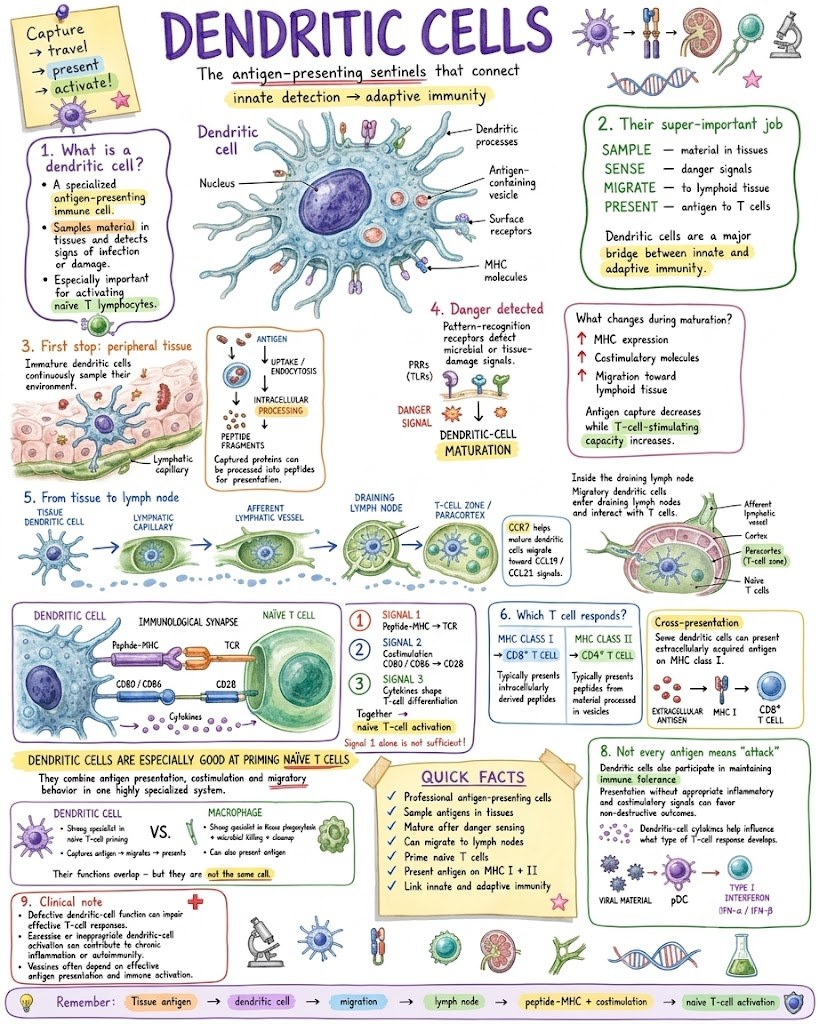
The dendritic cell samples → senses → migrates → presents. It is the teacher that shows the antigen to T cells.
A T cell wakes up only with three signals
| Signal 1 | peptide-MHC ↔ TCR: "is this the right enemy?" |
|---|---|
| Signal 2 | CD80/86 ↔ CD28 co-stimulation: "is it dangerous?" |
| Signal 3 | cytokines: "what kind of T cell should I become?" |
Why your arm hurts and you feel feverish after the shot: it is the sign that the immune system is training. Lymph nodes swell because one T cell is multiplying into thousands (clonal expansion).
7Myths and facts: true or not? 7 min
Decide first whether each statement is true, then check. The scientific fact appears with the answer.
8Wrap-up: three sentences 3 min
Designing an mRNA vaccine: DNA sequence → find the mutation → design the mRNA → synthesis
A personalised cancer vaccine is made in four steps: read the patient's tumour DNA, find mutations (neoantigens) that normal cells lack, write them into a blueprint (mRNA), then synthesise it in a test tube and pack it into LNPs. It is the very road Paul walked for Rosie in Coding for Rosie. Reference: theory PDF pages 19, 23, 24; practice PDF page 8 (the "ribosome slot machine" example); novel chapters 6–8 (Korean).
1DNA sequencing data: inside 200 gigabytes 10 min
A sequencer reads the DNA of tumour tissue and of normal tissue (blood) in millions of fragments and writes them to files. Paul received four files for Rosie (tumour and normal, two each), 200 gigabytes in all. Software aligns both sequences to the reference genome and looks for differences present only in the tumour (variant calling, for example with Mutect2). Paul got 4,847 candidates; choosing the ones the immune system could recognise was the next task.
2Find the mutated gene yourself 15 min
Below is the beginning of the human KRAS gene (codons 1–18). The top row was read from normal cells, the bottom row from tumour cells. Click the codon that differs in the tumour row.
Read it with the codon table: three bases = one amino acid
When a DNA codon is copied into mRNA, T becomes U. Use the small (partial) codon table below.
| mRNA codon | Amino acid | mRNA codon | Amino acid |
|---|---|---|---|
| GGU · GGC · GGA · GGG | Glycine (Gly, G) | GAU · GAC | Aspartate (Asp, D) |
| GUU · GUC · GUA · GUG | Valine (Val, V) | GCU · GCC · GCA · GCG | Alanine (Ala, A) |
| AUG | Methionine (Met, M) · start | UAA · UAG · UGA | stop |
KRAS G12D really is one of the most common mutations in pancreatic and colorectal cancer. When the short peptide containing the mutated position, VVVGADGVGK, is displayed on the tumour cell's MHC, it becomes a "neoantigen" that normal cells do not have. This is the "enemy's face" the vaccine will teach.
3Design the mRNA: seven parts, 5′→3′ 15 min
The blueprint of the neoantigen peptide (the ORF) alone will not be read by the cell. Without a cap and a tail, the cell treats it as an intruder and degrades it at once. Click the parts in 5′ → 3′ order to assemble the mRNA.
| Part | Role | In vaccine design |
|---|---|---|
| 5′ cap | protective hat · handle for the ribosome | no cap → immediate degradation |
| 5′ UTR | introduction (not translated) | a stable UTR borrowed from the globin gene |
| AUG + signal peptide | start codon and "delivery address" | routes the antigen into the MHC pathway |
| ORF (antigen) | coding sequence = antigen blueprint | several neoantigens joined together |
| stop codon | UAA · UAG · UGA | without it the ribosome cannot stop |
| 3′ UTR | closing words · lifetime control | a stable UTR extends the lifetime |
| poly(A) tail | AAAA… stability | when the tail wears down, degradation begins |
One more thing: uridine (U) is swapped for a modified nucleoside (pseudouridine, m1Ψ) so the cell's RNA sensors (TRIM25 and others) do not treat the mRNA as an intruder. The 2023 Nobel Prize in Physiology or Medicine (Karikó and Weissman) was awarded for exactly this discovery.
4Synthesising the vaccine: in-vitro transcription and LNP packaging 15 min
The designed sequence is made into a plasmid DNA template, and in a test tube RNA polymerase synthesises the mRNA in bulk (in-vitro transcription, IVT). No cells or viruses need to be cultured. After purification and quality control, the mRNA meets the lipids in a microfluidic mixer and becomes LNPs. Click the steps in order.
When the four lipids dissolved in ethanol meet the mRNA in pH 4 buffer inside the mixer, the positively charged ionizable lipid grabs the mRNA and the whole thing self-assembles into 100 nm particles.
How the finished LNP gets into a cell. In class 3 you will go in yourself as the nanoman.
5Wrap-up 5 min
Become the nanoman: carrying the mRNA vaccine into the cell
You are the nanoman, shrunk to 100 nanometres. On your back you carry the mRNA vaccine wrapped in an LNP. From the needle to the tumour you will pass fifteen gates. At each gate, read the short story, answer the choice question, and write one or two sentences in your first-person travel log. It is the same road as chapters 4–6 of the game Prince of mRNA, scenes 4–7 of the play, and chapter 13, "Injection", of the novel.
★Before you leave: the nanoman's vehicle, the dendritic cell at a glance 8 min
From gate 1 to gate 11 the nanoman rides a single dendritic cell. Capture → migrate → present → activate: this cell's day is the first half of the vaccine. Skim the infographic for two minutes, then do the "poster hunt". Click the image to open it full size.
🔍 Poster hunt: tick each one you find
🧭 Match poster sections to the nanoman's gates
Choose at which gate of the journey below each poster scene happens.
Landing: from the needle tip into the tissue
Swallowed: endocytosis
Endosomal escape: watching the pH gauge
A virus escaping the endosome and using the ribosome. The mRNA vaccine borrows only this "trick" from viruses and has no ability to replicate.
Running from the nucleases
Reaching the ribosome: synthesising the antigen peptide
Posted on MHC: hanging out the enemy's face
The long road to the lymph node
Meeting the herd of young T cells
Finding the match: key and lock
Arming the young T cell into a soldier
Clonal expansion: one becomes hundreds of thousands
Charging at the cancer cells
The immune checkpoint: the cancer cell's shield
Breaking through: help from the anti-PD-1 antibody
Killing the cancer cell: a quiet death
★Wrap-up: draw the map of the journey
Mission: you are a KOICA volunteer
Reference: practice slides (PDF, Korean) pages 5–14; example apps ONCO-PURGE and Ribosome Slot Machine.
You have arrived as a KOICA (Korea International Cooperation Agency) volunteer in a poor village where the power often fails. A rumour that "mRNA vaccines are dangerous" is going around, and children are not being vaccinated. Mission: teach the village youth how mRNA vaccines work.
Means: build an mRNA vaccine education game that runs on a single phone and use it in class. To do that, first play the game made by Sharing and Technologies and learn what works.
1Reconnaissance: play Prince of mRNA 25 min
- Open prince.aiedus.org (phone or laptop, nothing to install)
- Enter your name and class code → live ranking on the classroom screen
- Move: arrow keys/WASD · jump: space · interact: E · tutorial: ?
- You may start from chapter 3 (Chapter Select). First to clear the tumour wins. Press F3 for English.
Recon log: tick the chapters you cleared
2My own game scenario: a one-page plan 20 min
Start small, go deep. A game that handles one or two science steps accurately beats one that skims all six. The format may be a game, a play or a novel.
| Science step | As a scene or rule | Enemy · danger |
|---|---|---|
| ① Design and assembly | A puzzle putting the 7 parts in 5′→3′ order | Wrong order and the ribosome cannot read it |
| ② LNP packaging | Matching the ratio of 4 lipids, running the mixer | RNases cut naked mRNA |
| ③ Cell entry and escape | Timing on the pH gauge | Too late: lysosome; too early: failure |
| ④ Translation | Matching codons to amino acids | A time limit as the poly(A) tail wears down |
| ⑤ Antigen presentation and T cells | Matching key (antigen) to lock (TCR), three signals | With only one signal the T cell falls asleep |
| ⑥ Attacking the tumour | Telling cancer cells from normal cells and attacking | PD-L1 shield → break it with the antibody |
3Build your first game in Google AI Studio 15 min
- aistudio.google.com: sign in with a Google account (free)
- Left menu Build → the app description box
- Copy the auto-generated prompt below, paste it in and send
- Play it right away in the preview on the right → fix it by chatting ("the score does not go up", "make the buttons bigger")
- Download → index.html (or a ZIP) = your game. File name: class_name_title.html
Alternative: stivibe.iotok.org/create works the same way.
Auto-generated prompt: fill in the plan above and it is assembled here in the six-line template
The six lines of a good prompt: ① role and purpose ② format (one HTML file, language, phone and PC, no external libraries) ③ screen ④ rules and state ⑤ science (write exact facts yourself, never invent) ⑥ finish (help, restart, a science summary on the result screen)
Improving the game: working, correct, fun, then pretty
The order matters. ① Does it run? → ② Is the science right? → ③ Is it fun? → ④ Does it look good? AI makes plausible mistakes. You are the reviewer. Reference: practice PDF pages 15–21.
1Fix log: one thing at a time 25 min
Bad request: "the score does not go up" / "make it more fun"
Good request: "The score should rise by 100 on a successful escape but stays at 0. Fix it." / "When I fail, show one line explaining why, with the pH value."
| # | Problem found | Request sent to the AI | Result |
|---|---|---|---|
| 1 | |||
| 2 | |||
| 3 |
Common blockers
| Symptom | Fix |
|---|---|
| The screen is blank | Copy the red error from the F12 console: "fix this error" |
| Images do not show | Check file name, extension and capitalisation, and that it sits in the same folder as index.html |
| Buttons are tiny on the phone | "Make the buttons finger-sized (at least 48 px) and support touch events" |
| No sound | Browsers allow sound only after the first tap → "play after the start button" |
| The AI ignores my request | New chat → paste the current file → ask for one thing only |
2Science accuracy checklist: a wrong app spreads wrong knowledge 10 min
Open your game and compare line by line. Lines that do not apply may be ticked as "not applicable". 40% of the mark depends on this.
3Image assets: draw with Gemini and put them in the app 15 min
- Add the same style sentence to every image for consistency ("bright educational cartoon style, thick outlines, simple background")
- Save in the same folder as index.html ·
<img src="lnp.png">· tell the AI the file name - If an image does not show: file name, extension, capitalisation
4Friend test: can they start within a minute without explanation? 10 min
Completion criteria: checklist before presenting
Demonstrate to friends, get reviewed, and wrap up what you learned
Upload 10 min → 3-minute talk per team → peer review → wrap-up. Reference: practice PDF pages 22–26.
1Release it to the world: upload to stivibe.iotok.org 10 min
2The 3-minute talk: science 1 min · demo 1 min 30 s · what I learned 30 s 25 min
3Peer review: science is 40% 15 min
| Item | Points | What to look for | Score |
|---|---|---|---|
| Scientific accuracy | 40 | All 7 checklist lines pass · order, numbers, terms · the talk explains the principle correctly | |
| Teaching effect | 20 | Starts within a minute unaided · afterwards you can state the principle in one sentence · science summary on the result screen | |
| Polish | 20 | No errors · works on a phone · consistent images and style · restart and help | |
| Presentation | 20 | Keeps to 3 minutes · a clear science minute · the demo links rules to science · answers questions |
4What I learned: the final quiz 10 min
Questions across all six classes. Answer them all, then check your score.
5Looking back: from learner to teacher
- Science must be accurate to be passed on. The fear of the pandemic came from not knowing. The app we built passes on the accurate principle simply.
- AI is a tool. What to build, whether the science is right and whether it is fun are decided by people. A prompt is the result of thinking.
- You learn best by teaching. Send the link to your family and explain it. If you can explain it, you really know it.